Cereal, Couch, Cartoons: How Saturday Morning TV Became the Sacred Ritual We're Still Chasing
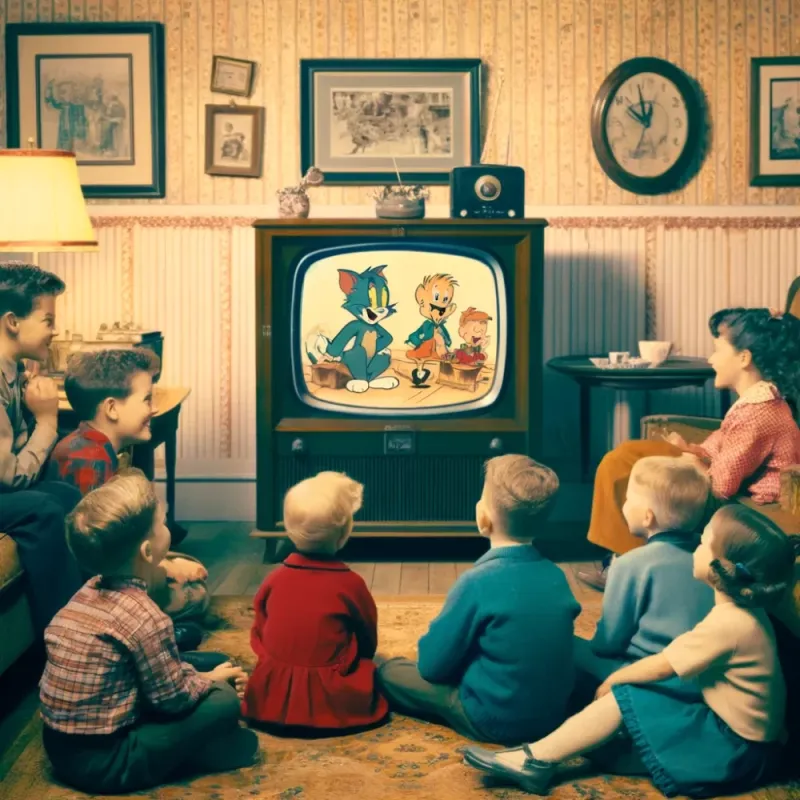
Photo: child watching Saturday morning cartoons on TV in 1980s living room with cereal bowl, via www.savingadvice.com
There's a very specific kind of happiness that hits when the DuckTales theme song starts playing. It doesn't matter if you're 38 years old, sitting in your apartment at midnight with a glass of wine instead of a bowl of Cocoa Puffs — something just clicks. Your shoulders drop. You smile without meaning to. For about 22 minutes, everything is fine.
This is not a coincidence. And you are definitely not alone.
Across the country, adults who grew up glued to Saturday morning television are logging onto Disney+, Paramount+, and Tubi to revisit cartoons they haven't thought about in decades. The numbers are real — DuckTales, the 1987 original, consistently trends on Disney+ whenever a new generation of parents introduces it to their kids. The 90s X-Men animated series generated such a massive wave of adult nostalgia that Marvel actually revived it as X-Men '97 in 2024. Teenage Mutant Ninja Turtles never really went away. And Animaniacs got a full reboot on Hulu because the demand was simply too loud to ignore.
So what's going on here? Why are we so obsessed with going back?
The Saturday Morning Ritual Was Unlike Anything Else
To understand the pull, you have to understand what Saturday mornings actually meant to kids growing up in the late 70s, 80s, and early 90s. This wasn't just passive TV watching. It was a full-on weekly event with its own rules, its own preparation, and its own emotional payoff.
You woke up before your parents — voluntarily, which almost never happened on school days. You shuffled to the kitchen in your pajamas, poured yourself a bowl of whatever sugar-bomb cereal your mom had reluctantly bought, and planted yourself in front of the TV. The networks — ABC, NBC, CBS — had basically constructed a four-hour block of programming designed specifically for you. Not for adults. Not for families. For kids.
There was something almost ceremonial about it. The week was over. School was done. And for those few morning hours, the television belonged entirely to you.
"I remember setting my alarm for 7 a.m. on Saturdays," says Marcus, 41, a high school teacher from Columbus, Ohio. "My parents would sleep until 9 or 10, and I had the whole living room to myself. Thundercats, then He-Man reruns, then whatever came next. I didn't move. It was the most free I felt all week."
That sense of ownership — of time and space that was genuinely yours — is something a lot of adults say they're quietly mourning when they go back to these shows.
The Psychology of Cartoon Comfort
Nostalgia researchers (yes, that's a real field, and it's booming) have spent the last decade documenting why people return to childhood media during periods of stress or uncertainty. Dr. Constantine Sedikides at the University of Southampton has published extensively on nostalgia as a psychological resource — something humans use to regulate emotions, reinforce identity, and feel connected to a sense of self that predates adult complexity.
In plain terms: when life feels chaotic or heavy, going back to something that felt safe and simple is a genuinely effective coping mechanism. It's not childish. It's actually pretty smart.
And Saturday morning cartoons carry an unusually dense emotional charge. They're tied not just to the shows themselves but to a whole constellation of sensory memories — the smell of cereal, the feel of a couch cushion, the specific quality of weekend morning light. Rewatching He-Man or Rugrats or Gargoyles doesn't just trigger memories of the show. It triggers memories of being that kid, in that house, with zero responsibilities and a whole weekend ahead.
"It's basically time travel," says Priya, 36, a marketing director from Austin, Texas. "I put on the original DuckTales and I'm seven years old again. My biggest problem is whether Scrooge is going to outsmart the Beagle Boys. That's a really nice problem to have for 22 minutes."
The Shows That Are Having Major Comeback Moments
Not every Saturday morning classic has aged the same way, but a handful of titles are experiencing genuine cultural revivals that go beyond simple nostalgia tourism.
X-Men: The Animated Series is probably the biggest story. When Disney+ added the original 90s run, it became one of the platform's most-watched catalog titles almost immediately. The subsequent revival, X-Men '97, picked up exactly where the original left off — same animation style, same voice actors, same moral complexity — and became one of the most talked-about animated shows of 2024. Critics who hadn't thought about the show in 30 years were writing serious analytical pieces about it.
DuckTales (1987) remains a gold standard. The 2017 reboot introduced it to a new generation, but the original continues to draw adult viewers who want the real thing. There's a reason "Life is like a hurricane" still gets stuck in people's heads without any prompting.
Gargoyles has developed a cult following so passionate that it almost defies explanation. The show, which ran from 1994 to 1997, tackled themes of prejudice, identity, and belonging with a seriousness that was genuinely unusual for Saturday morning TV. Fans have been campaigning for a revival for years, and Disney has been quietly listening.
Animaniacs and Tiny Toon Adventures both returned via Hulu reboots, though the original runs remain the sentimental favorites for anyone who grew up with them.
What These Shows Actually Taught Us
Here's the thing that surprises a lot of people when they go back and rewatch these cartoons as adults: they hold up better than expected, and not just emotionally.
The 90s X-Men series was explicitly about civil rights and systemic discrimination. Gargoyles explored themes of cultural erasure and identity politics. Even DuckTales, underneath all the adventure and comedy, was fundamentally a show about family, loyalty, and what you owe the people who raised you.
These weren't throwaway entertainment. They were the first place a lot of kids encountered complex moral questions — and they handled them with more nuance than adults probably gave them credit for at the time.
"I rewatched the X-Men series with my teenage daughter last year," says David, 44, from Portland, Oregon. "She was riveted. And I kept thinking, this show was doing the work. It was teaching empathy through Cyclops and Storm and Rogue. I didn't fully appreciate it at the time, but it definitely shaped how I think about fairness and belonging."
The Good Old Days Are Streaming Right Now
Maybe the most comforting part of this whole nostalgia wave is that the access has never been easier. You don't need a VHS tape or a working VCR or a friend who recorded everything on a six-hour SLP tape. You just open an app.
And in a media landscape that can feel overwhelming and relentless, there's something genuinely lovely about the fact that these old cartoons are still there — still exactly as you remembered them, still tied to those specific Saturday morning feelings.
So go ahead. Make yourself a bowl of cereal. Find the couch. Hit play on DuckTales or Thundercats or whatever show made your Saturday mornings feel like the best hours of the week.
Those good old days? They're only a click away.