Dear Diary, We're Back: The Quiet Revolution of Pen, Paper, and Slowing the Heck Down
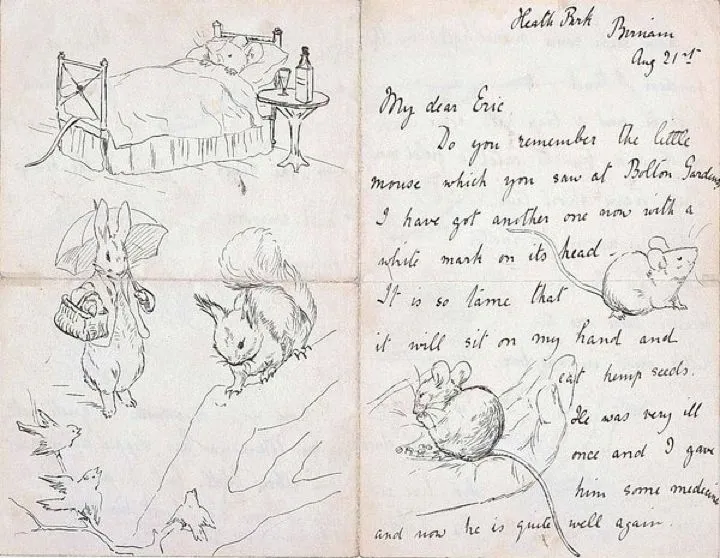
Photo: Beatrix Potter Journal entry, Public domain, via Wikimedia Commons
Somewhere in America right now, someone is sitting at a kitchen table with a cup of coffee, a good pen, and a blank piece of paper — and they are writing a letter. Not typing one. Not dictating one into their phone. Actually writing it, in their own handwriting, with stamps already waiting on the counter.
Somewhere else, someone is opening a paper planner and drawing a little box next to Tuesday's to-do list. And somewhere else still, a person is settling into the ritual of a morning journal entry before the phone even gets touched.
None of this is accidental. The analog comeback is real, it's growing, and it is saying something pretty loud about the way a lot of us are feeling about our digitally saturated lives.
When Did Screens Stop Being Enough?
For a while there, it seemed like paper was on its way out. Why keep a physical calendar when your phone syncs everything automatically? Why write a letter when you could text in seconds? Why journal longhand when a notes app is right there?
The answers to those questions seemed obvious — until they didn't.
At some point, the infinite convenience of digital life started to feel less like freedom and more like noise. Notifications stacking up. Inboxes that never empty. The particular exhaustion of staring at a glowing rectangle for ten hours and then being handed another glowing rectangle to relax with. Something about it stopped feeling like progress and started feeling like a treadmill.
And that's when people started reaching for their grandma's stationery.
The Letter That Actually Means Something
Handwritten letters have a power that is genuinely hard to explain to someone who hasn't received one recently — so go ahead and try the experiment. Mail something to a friend. Not a card with two lines inside. A real letter, front and back, in your actual handwriting, talking about actual things.
Watch what happens when they get it.
There's a reason letters get saved in shoeboxes and keepsake bins while emails get deleted without a second thought. A handwritten letter is a physical record of someone's time, attention, and the specific way their hand moves across a page. It's intimate in a way that a perfectly formatted email — no matter how heartfelt — simply cannot be. You can feel the pressure of the pen. You can see where they paused and crossed something out. The whole messy, human process is right there on the page.
The USPS reported a notable uptick in personal mail during and after the pandemic years, and specialty stationery shops — both online and brick-and-mortar — have seen sustained interest from customers who want something more than a text message to mark important moments. Wax seals are back. Fountain pens are back. People are haunting estate sales for vintage writing sets, and they mean it.
The Bullet Journal and the Beautiful Chaos of Planning on Paper
If handwritten letters are the sentimental arm of the analog revival, bullet journaling is its productivity-obsessed cousin — and the two have more in common than you might think.
The bullet journal system, originally laid out by designer Ryder Carroll, is at its core just a method for organizing your life in a blank notebook with a pen. No app required. No subscription. No algorithm deciding what you should prioritize. Just you, your handwriting, and a system you build yourself.
What started as a productivity niche has grown into a full subculture, with millions of people sharing their spreads on social media — which is genuinely funny, when you think about it. People are using digital platforms to celebrate their escape from digital platforms. But the appeal is real regardless of the irony: a paper planner doesn't ping you. It doesn't update itself. It doesn't send you a push notification at 11 PM. It just sits there, waiting patiently, exactly where you left it.
For people who grew up watching their parents keep actual paper calendars on the refrigerator, or who remember the satisfying thunk of a Day-Timer planner, there's a deep well of comfort in returning to something that works without wifi.
Journaling as a Meditation (Even If You're Not the Meditating Type)
Here's something your seventh-grade English teacher probably tried to tell you: there is something genuinely different about what happens in your brain when you write by hand versus when you type.
Research backs this up — the physical act of handwriting engages more cognitive processing than typing, which tends to become automatic and fast. Writing by hand forces you to slow down, to choose words more carefully, to actually sit with a thought long enough to complete it. It's less efficient by every measurable standard, and that inefficiency turns out to be the entire point.
A lot of people who've returned to journaling describe it the same way: not as a task, but as a transition. A ritual that marks the space between the rushing-around part of the day and the settling-down part. Something that exists entirely outside the attention economy, where no one is waiting for your response and nothing requires immediate action.
Our grandparents called this keeping a diary, and they did it with devotion. Those old diaries — the ones you find tucked in drawers or passed down through families — are some of the most treasured documents we have of what everyday life actually felt like. Not the highlight reel. The real thing.
What the Analog Revival Is Really About
Pull back far enough and the handwriting revival, the letter-writing resurgence, and the paper planner obsession are all pointing at the same thing. They're all ways of insisting that some moments deserve more than a quick tap on a screen. That attention is worth something. That the slow, imperfect, physical version of doing things carries a kind of meaning that the frictionless digital version doesn't.
That's not a new idea, of course. It's practically the oldest idea there is. But there's something genuinely moving about watching people rediscover it — about a generation raised on smartphones choosing, deliberately, to pick up a pen.
Your grandmother's handwriting on a birthday card. The love letter your grandfather kept in his wallet for fifty years. The diary your mom wrote in every night before bed.
They were onto something. Turns out we just needed a little while to figure that out.