Sniff Once, Sniff Twice, Never Let Go: The Scratch-and-Sniff Sticker Craze That Turned Every Kid Into a Collector
Let's be honest about something. The pizza didn't smell like pizza. The watermelon was closer to watermelon-adjacent candy than actual fruit. And the grape? Well, the grape smelled like purple. Just... purple. But none of that mattered, because the moment your thumbnail dragged across that little waxy circle and that burst of synthetic scent hit your nose, you were completely, utterly hooked.
Scratch-and-sniff stickers weren't just a product. They were a whole economy. A social system. A ranking structure as complicated and cutthroat as anything you'd find on Wall Street, except the currency was scented paper and the trading floor was a second-grade classroom.
Where the Whole Thing Started
The technology behind scratch-and-sniff — microencapsulation, for those keeping score — was actually developed in the 1960s by a 3M researcher named Gale Matson. The basic idea was elegant: tiny fragrance capsules bonded to a surface, released when you broke them open with friction. For years, it was mostly used in industrial and commercial applications, the kind of thing you'd never think to hand a seven-year-old.
Then somebody did exactly that, and the world changed.
By the late 1970s, scratch-and-sniff stickers were showing up in classrooms and toy stores across America. Mello Smello, Trend Enterprises, and a handful of other companies started cranking out sheets of the things in every scent imaginable — root beer, cinnamon, popcorn, chocolate, mint, coconut, and a rotating cast of fruit smells that bore only a passing resemblance to their real-world inspirations. The 80s turned the whole thing into a full-on cultural moment. By the early 90s, scratch-and-sniff stickers were as fundamental to American childhood as Saturday morning cartoons and Happy Meals.
The Hierarchy Was Real and It Was Serious
If you were there, you already know: not all scratch-and-sniff stickers were created equal. There was a very clear, very understood pecking order, and trading without knowing the hierarchy was social suicide.
At the top of the food chain sat the rare ones. The pizza sticker. The root beer float. The buttered popcorn, which smelled nothing like real popcorn but somehow smelled exactly like what popcorn should smell like in a perfect world. These were blue-chip assets. You didn't trade them away unless you were getting something equally legendary in return.
Mid-tier was where most of the action happened. Strawberry, watermelon, cherry — reliable, pleasant, widely available. Good for everyday trades. The equivalent of a crisp twenty in a barter economy.
And then there were the stickers that, bless their hearts, just didn't land. Licorice was divisive. Anything floral felt like something your aunt would like. And there was always at least one mystery scent per sheet that smelled vaguely like a hardware store and made everyone uncomfortable.
Knowing the hierarchy, negotiating trades, building a collection that reflected genuine taste and savvy — that was the whole game. And it was a remarkably sophisticated game for people who still needed help tying their shoes.
The Album Was Everything
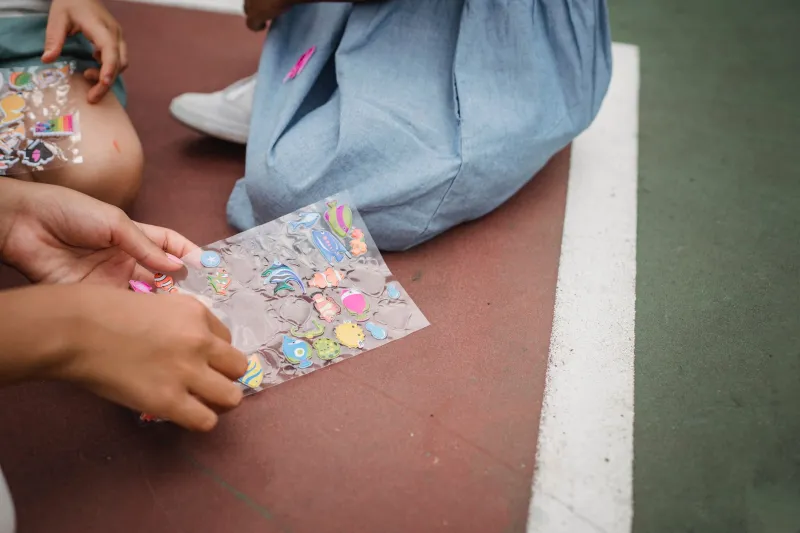
You couldn't just have stickers. You had to store them properly. For a lot of kids, this meant a dedicated sticker album — those puffy-covered binders with plastic sleeves that let you display your collection without sacrificing the precious scratch-and-sniff coating. The arrangement mattered. You grouped by scent family, or by rarity, or by some personal aesthetic logic that made complete sense to you and no one else.
The album also served a social function. Bringing it out on the playground was an invitation — come look, come trade, come see what I've built. It was a portfolio and a conversation starter and a status symbol all at once. The kid with the fullest, most impressive sticker album occupied a very specific kind of social real estate that's hard to explain to anyone who wasn't there.
And the smell of the album itself, after a while — that layered, complicated bouquet of a hundred different synthetic scents all blending together — was its own distinct sensory memory. There is genuinely nothing else that smells like a well-used scratch-and-sniff sticker collection, and if you've ever caught a ghost of it somewhere, you know exactly what we're talking about.
Teachers Got In on It Too
Here's a detail that tends to get glossed over: scratch-and-sniff stickers weren't just a kid-to-kid phenomenon. Teachers were in on it. Getting a scratch-and-sniff sticker on a graded paper — especially one of the good ones, the pizza or the root beer — was a legitimate thrill. It communicated something beyond a letter grade. It said I see you, nice work, here's something delightful.
Some teachers were more generous dispensers than others, and that reputation preceded them. The teacher who handed out scratch-and-sniff stickers freely was beloved in a way that transcended normal student-teacher dynamics. It was a simple, cheap, profoundly effective motivational tool, and it worked because the stickers carried genuine perceived value in the kid economy.
Why They Still Hit Different
Scent is the sense most directly wired to memory. It bypasses the parts of the brain that process language and logic and goes straight to the emotional core — which is why a single whiff of something from childhood can drop you back into a specific afternoon in a way that a photograph sometimes can't.
Scratch-and-sniff stickers were, in a way, portable memory devices. Each scent became associated with a specific time, a specific classroom, a specific trade, a specific feeling. The watermelon one smells like the last week of third grade. The cinnamon one smells like a Tuesday in November when something good happened that you can't quite name anymore.
That's not nothing. That's actually kind of extraordinary.
The Comeback Is Real
Here's the good news for anyone who's been quietly nostalgic about all of this: scratch-and-sniff stickers never fully went away, and right now they're having a genuine moment. Independent stationery brands and Etsy sellers are producing small-batch scratch-and-sniff stickers aimed squarely at adults who remember the originals. Novelty gift shops carry them. A few clever food and beverage brands have used them in marketing campaigns specifically to trigger that nostalgic nerve.
And the kids of today? They're into them too. Which makes a certain kind of sense — the appeal of something small, tactile, and immediately rewarding is pretty timeless, and the novelty of a sticker that actually does something lands just as hard in 2024 as it did in 1987.
The First Thing We Ever Truly Collected
Looking back, scratch-and-sniff stickers were a lot of things we didn't have words for at the time. They were an introduction to concepts like scarcity and value. They were an early lesson in negotiation and social currency. They were a reminder that sometimes the things that matter most are small, slightly weird, and smell vaguely like something they're not.
Mostly, though, they were just really fun. The kind of fun that doesn't require a screen or a subscription or a tutorial. The kind of fun that lives in your fingertips and your nose and somewhere deep in your memory, waiting for the right trigger to bring it all flooding back.
Go find a scratch-and-sniff sticker. Scratch it. Sniff it. You'll see exactly what we mean.