Twenty-Seven Shots and No Do-Overs: The Beautiful Chaos of Disposable Cameras at Every Party
Somewhere in a shoebox — probably shoved under a bed in your childhood bedroom or tucked into a closet at your parents' house — there's an envelope of developed photos that tells the real story of a night you thought you remembered perfectly. Blurry faces mid-laugh. Someone's thumb covering half the frame. A group shot where three people have red eyes and one person blinked. And yet, flipping through those photos feels like holding something genuinely sacred.
That was the disposable camera era, and honestly? It was peak friendship documentation.
The Camera Nobody Owned but Everyone Used
The beauty of the single-use camera was its absolute lack of pretension. You didn't buy one because you were a photographer. You grabbed a Kodak FunSaver or a Fujifilm QuickSnap off a spinning rack near the drugstore checkout — usually the same rack that sold AA batteries and ChapStick — because someone's birthday was coming up, or prom was this weekend, or your best friend was throwing a pool party and you just knew it was going to be a whole thing.
They cost somewhere between six and twelve dollars depending on whether you splurged for the waterproof version (worth it, always worth it), and they came preloaded with 24 or 27 exposures. That was it. That was your entire night, compressed into a little cardboard rectangle with a plastic lens and a flash that charged up with a tiny whine you could feel in your thumb.
No settings. No zoom. No second chances. Just point, press, and hope.
The Art of Rationing Your Shots
Here's something today's photo-happy culture has completely lost: the strategic weight of a limited number of frames. When you only had 27 shots to capture an entire evening, every click was a small commitment. You didn't photograph your dinner. You didn't take fifteen nearly identical photos of the same moment just to pick the best one later. You made a judgment call — this is the shot — and you took it.
Sometimes that instinct was right. Sometimes you ended up with a beautifully candid photo of your two best friends losing it over some inside joke, caught in the kind of genuine, unguarded laughter that staged photos never quite replicate. And sometimes you wasted three frames trying to capture the sunset over the lake and got nothing but orange blur.
Either way, you owned it. The imperfection was part of the deal.
There was also something quietly social about passing the camera around. At any given party, the disposable camera was a shared object — a little baton of collective memory that moved from person to person throughout the night. Whoever had it became the unofficial historian for those twenty minutes. And because nobody could immediately review what they'd taken, there was no performance anxiety, no retakes, no pulling everyone back together because the lighting was wrong. You just lived the moment and trusted the camera to catch whatever it caught.
The Week-Long Wait That Made Everything Matter
If the shooting was chaotic and joyful, the developing was its own particular kind of torture. After a party, the camera would sit on your dresser — or in the bottom of your bag, or on the kitchen counter — for days, sometimes weeks, before anyone got around to dropping it off at the drugstore. And then you waited another hour, or a day, or until next Tuesday, depending on whether you sprung for one-hour developing or just did the regular drop-off.
By the time you actually held those prints in your hands, the night felt both recent and somehow already nostalgic. You'd look at a photo and think, oh, I completely forgot about that moment, and suddenly the whole evening would come flooding back in a way that scrolling through a camera roll never quite triggers. The delay created distance, and distance created perspective. Those photos weren't just documentation — they were a reunion with a version of yourself and your friends that had already, slightly, become the past.
You'd spread them out on a bed or a kitchen table and narrate each one. "Oh my God, who took this?" "Wait, I didn't even know you two talked that night." "We have to make copies of this one — everyone needs this photo."
That ritual of gathering around physical prints and experiencing them together? There's genuinely nothing in the smartphone era that replicates it.
Nobody Looked Perfect and That Was the Whole Point
Here's the thing about disposable camera photos that's almost impossible to overstate: they were radically, beautifully unflattering in the best possible way. The flash washed everyone out. Indoor shots were grainy. Outdoor shots were occasionally overexposed into near-white oblivion. Candid angles caught double chins and weird expressions and someone always, always had their eyes closed.
And nobody cared. Because everyone looked the same level of imperfect, and the imperfection was proof that the moment was real.
Compare that to the modern party photo experience, where a single group shot can require eight attempts, two people demanding retakes, a debate about which filter to use, and a ten-minute delay before anyone can actually go back to having fun. The curation pressure is exhausting. The disposable camera asked nothing of you except to show up and be present, and in return it gave you something that felt genuinely, messily human.
Why We're Bringing Them Back
It's not a coincidence that disposable cameras started showing up at weddings again a few years ago — little baskets of them on reception tables, inviting guests to just shoot without agenda. It's not a coincidence that Gen Z, who grew up entirely within the smartphone era, has developed a real appetite for film photography, lo-fi aesthetics, and the specific texture of analog imperfection.
There's a hunger for something that feels less curated, less optimized, less permanent in its pursuit of permanence. The disposable camera, in all its grainy, thumb-obscured glory, delivered exactly that.
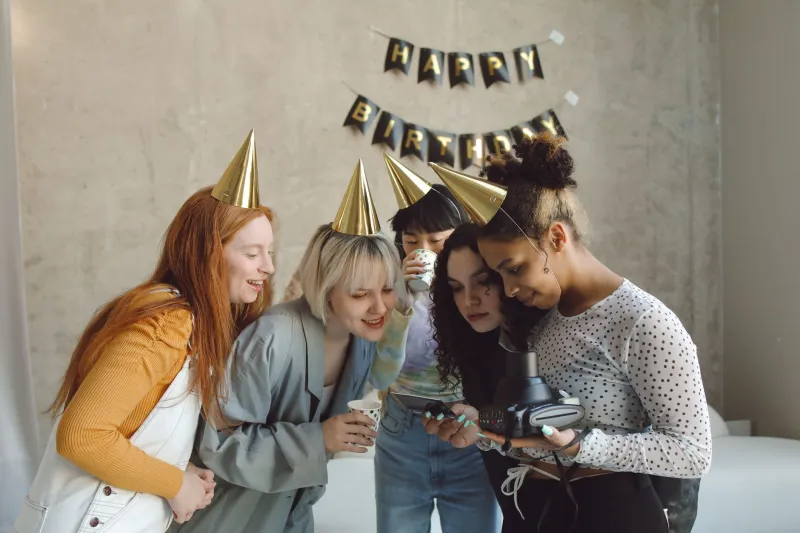
So if you've got a birthday coming up, a summer cookout on the calendar, or just a Friday night with people you love — consider picking one up. Toss it on the table. Watch what happens when nobody can immediately review what they just shot. Watch how people loosen up, laugh more, stop performing.
Then wait a week. Get the prints. Spread them out somewhere.
That shoebox under the bed is waiting.