Folded Into Fourths and Slipped Through the Slots: The Quiet Power of a Note Passed in Class
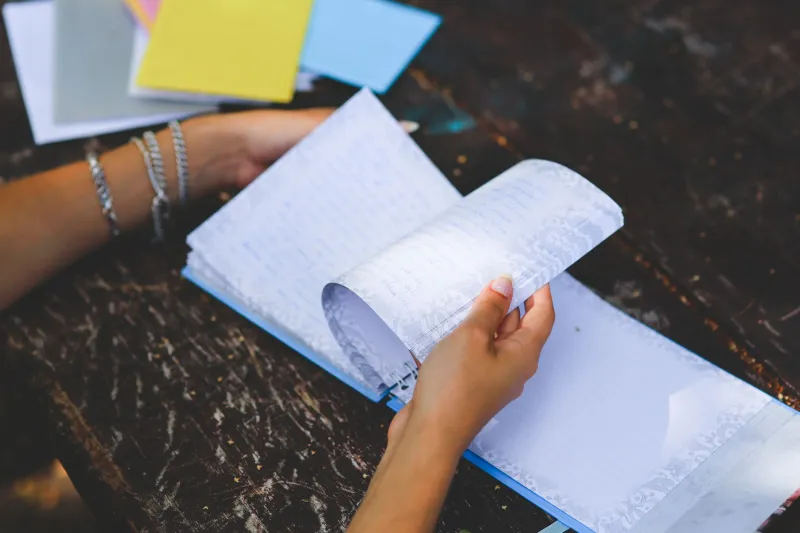
Somewhere between third period and lunch, a folded square of notebook paper would land on your desk. Maybe it skidded in from two rows over. Maybe it came through a trusted middleman — the kid who sat between you and the person who actually wrote the thing. Either way, the moment it touched your fingertips, your heart did something your phone has never once made it do.
It jumped.
Note-passing was its own entire civilization. It had customs, risks, unwritten rules, and a craft element that nobody ever formally taught you but everyone somehow mastered. If you grew up going to school before smartphones colonized every waking minute, you know exactly what we're talking about. And if you've spent any time lately staring at a screen full of gray text bubbles, you might find yourself wondering when exactly we agreed to trade all of that in.
The Origami of Wanting to Be Known
Let's start with the folding, because the folding mattered. A note wasn't just scrawled and handed over — that would've been sloppy, almost disrespectful. You folded it. Tightly. With intention. The classic was the rectangle, folded into thirds like a tiny business letter. But the real artistry lived in the square fold, the kind where the flap tucked into itself and formed a neat little packet you could palm in one hand. Some kids could fold a note into a football shape, a heart, a tiny envelope with a pull tab. The presentation was part of the message.
And the message itself? That was written in pen — or sometimes pencil, if you were nervous and wanted the option to erase. You chose your words carefully, even if the note just said do you like him? circle yes or no. The physical act of writing by hand slowed everything down in a way that forced a kind of honesty. You couldn't just fire off a reaction. You had to commit it to paper, fold it up, and send it into the world.
That's a completely different emotional transaction than tapping out a text.
The Delivery System Was Half the Drama
Getting the note to its destination was its own subplot. You had to read the room — was the teacher facing the board? Was the aisle clear? Could you trust the kid in the middle seat to pass it along without reading it, or worse, losing their nerve and just sitting on it until the bell rang?
The pass itself was a study in casual nonchalance. You slid the note to the edge of your desk. The next kid palmed it without looking. It moved down the row like water flowing downhill. Everybody played their part without a word, without eye contact, without acknowledgment. It was a small, beautiful act of collective cooperation.
And then there was the waiting. You couldn't see read receipts. You couldn't tell if they'd opened it yet. You just sat there, staring at the back of someone's head, wondering if they were reading it right now, wondering what their face was doing.
The suspense was genuinely excruciating. It was also genuinely alive.
What the Teacher Interception Actually Meant
Every note-passer lived in low-grade fear of the interception. The moment a teacher's hand shot out and plucked the note from mid-pass, time stopped. The whole class held its breath. Would they read it aloud? Some teachers absolutely would, and those teachers became legendary — not fondly, but in the way that formative traumas become legend.
But even the possibility of interception gave note-passing a weight that digital communication has completely lost. When you put something on paper and sent it into the world, you were taking a real risk. You were making yourself genuinely vulnerable. The stakes were physical. The note existed as an object that could be confiscated, unfolded, read by the wrong eyes, kept as evidence, or treasured forever.
Nothing about a text message carries that kind of gravity. You can unsend it. You can delete it. It evaporates. A note didn't evaporate. A note was real.
The Ones You Kept
Here's something worth sitting with: people kept notes. Actual, physical notes, folded up and tucked into the front pocket of a Trapper Keeper, or stashed in a shoebox under the bed, or pressed flat inside a yearbook. Some people still have them. Decades later, in a box in a closet somewhere, there are notes that say things like I think he likes you back and meet me by the gym after 5th and you're my best friend, don't forget that.
Try finding a text conversation from 2007. Go ahead. It's gone. The phone is gone, the carrier is gone, the backup never happened. That entire layer of your personal history just dissolved.
But the note in the shoebox? Still there. Still in someone's handwriting. Still smelling faintly of whatever the inside of a locker smelled like. Still folded exactly the way they folded it the day they wrote it.
That's not a small thing. That's a whole archive of who you were and who mattered to you, preserved in paper and ink.
Why It Hit Different
We throw that phrase around now — hits different — but it actually applies here in a literal way. Receiving a handwritten note activated something that a push notification simply cannot. The tactile experience of unfolding paper, the visual of someone's actual handwriting (loopy, cramped, bubble letters, whatever their style was), the private little world that existed between the writer and the reader — all of it created a sense of being specifically chosen that feels almost quaint to describe now.
Someone sat down, picked up a pen, thought about you, and wrote words with their own hand. Then they went through the whole elaborate ritual of getting those words to you without getting caught. That's effort. That's attention. That's a form of care that required more than thirty seconds and a thumbs-up emoji.
We're not here to pretend the old days were better in every way — they weren't. But some things genuinely were, and the handwritten note is one of them. Not because paper is superior to pixels, but because the process demanded something from both people. It demanded presence, patience, and a willingness to be a little bit brave.
Pass It On
If you feel the urge to resurrect this particular ritual, nobody's stopping you. Grab a piece of paper. Write something real to someone who matters. Fold it up. Leave it somewhere they'll find it.
You don't have to be in seventh grade for it to mean something. You just have to mean it when you write it.
And maybe that's exactly what we lost when we put the paper down — not just a method of communication, but the muscle memory of meaning what we say.