Same Movie, A Hundred Times, Zero Regrets: The Deep Magic of Watching Something Until You Knew Every Word
There was a specific kind of tired that came from watching The Lion King for the fourteenth time in a month. Not bored-tired. Not done-tired. The comfortable, warm, slightly glazed kind of tired that only happens when something is so familiar it stops being entertainment and starts being furniture. You weren't really watching it anymore. You were just... in it.
That's a feeling a lot of us have been quietly chasing ever since the streaming era handed us forty thousand titles and an anxiety spiral every Friday night.
The Shelf Was the Algorithm
Here's the thing nobody talks about when they're celebrating the miracle of on-demand everything: having fewer choices made us love things harder.
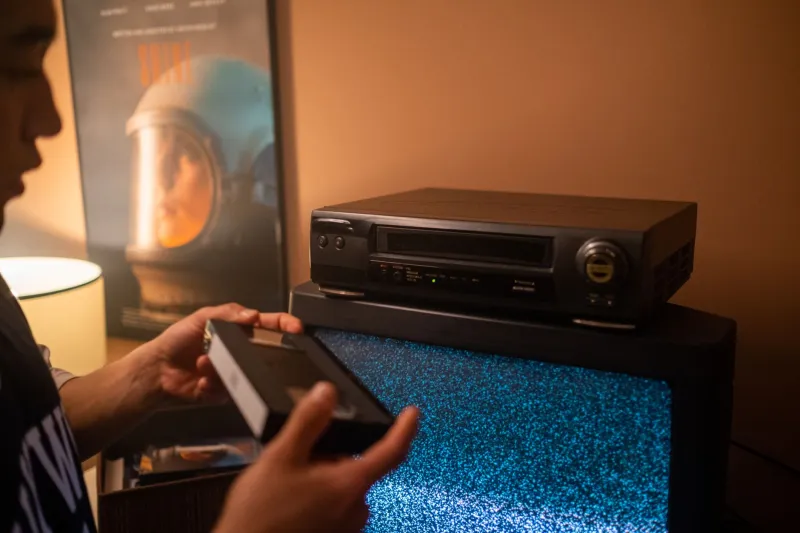
The average American household in the mid-nineties had a VHS collection that fit on one shelf — maybe two if your family was serious about it. You had the Disney stack. The action movies your dad bought at Walmart. The one your mom taped off HBO that was still technically her favorite even though the first seven minutes were a commercial for Jell-O pudding. That was the menu. Those were your options.
So you picked the one you loved most, and you watched it. Then you watched it again. Then your little brother wanted to watch it, so you watched it with him. By the time summer was over, you didn't just know the movie — you owned it in some cellular way. You could quote it in the dark. You knew the exact frame where the tape had gone a little fuzzy because someone rewound too fast. You knew the skip, the static, the slightly warped audio on the line that always made your dad laugh.
The movie wasn't just a movie. It was a place you kept going back to.
Why Rewatching Felt Like Visiting a Friend
Psychologists have a term for this — they call it "narrative transportation," which is a very clinical way of describing the feeling of being completely swallowed by a story. But what they've also found is that familiarity deepens that transportation rather than dulling it. When you already know what's coming, your brain relaxes into the experience instead of working to track the plot. You stop processing and start feeling.
That's why rewatching a movie you love isn't lazy. It's actually the most emotionally efficient thing you can do with two hours.
The kids who watched Sandlot every single summer weren't killing time. They were building something. A private interior landscape tied to that specific movie, that specific summer, that specific version of themselves sitting on that specific couch. Years later, one note of that soundtrack can pull the whole thing back — the smell of the room, the sound of the ceiling fan, the exact quality of afternoon light through the blinds.
Streaming doesn't do that. Streaming can't do that, at least not the same way, because streaming never makes you commit.
The Paradox of Infinite Choice
Here's the uncomfortable truth about having access to everything: it makes it really hard to love anything.
When you sit down with a subscription service tonight and scroll for twenty minutes before settling on something you've already seen, you're not being indecisive. You're experiencing what researchers call the paradox of choice — the well-documented psychological phenomenon where more options produce less satisfaction. Barry Schwartz wrote a whole book about it back in 2004, and somehow we've spent the twenty years since building the most extreme version of that paradox imaginable and then acting surprised when it makes us miserable.
The video store solved this problem without knowing it was solving anything. You drove to Blockbuster. You wandered the new releases. Most of what you wanted was already rented. You grabbed something from the family section because it was available and you were already there, and then you watched it, and then you watched it again the next weekend because it was still sitting on top of the TV and why not.
Limitation created intimacy. Scarcity made you stay.
The DVD Era Doubled Down
If VHS made us repeat viewers, DVD made us obsessive ones.
Suddenly there were special features. Director's commentaries. Deleted scenes. Making-of documentaries that were sometimes better than the actual movie. The physical disc became an artifact, and watching it became a ritual with multiple layers. You could spend an entire Saturday afternoon with a single film — the movie itself, then the commentary track, then the blooper reel, then the featurette about the costume department — and feel like you'd spent the day with something real.
People built DVD collections the way earlier generations built record libraries. You'd walk into someone's apartment and scan their shelves and learn something true about them in about thirty seconds. The movies a person owned, really owned, bought with their own money and kept on a shelf, said something that a watchlist never could.
A watchlist is an intention. A shelf is a commitment.
What We're Actually Chasing
The nostalgia for repeat viewing isn't really about VHS tapes or DVD menus or even the movies themselves. It's about the version of engagement those formats demanded.
When you only had a few things to watch, you paid attention differently. You let things in. You gave them the kind of repeated access that turns a movie into a memory, a character into a companion, a soundtrack into a shorthand for an entire period of your life.
That's why so many of us still have a movie — probably more than one — that we return to when we're sick, or sad, or just need something that feels like home. Not because it's the best movie ever made. Because we watched it enough times that it became part of us.
The good news is that the rewatching instinct never actually went away. It just got buried under the scroll. People still have their comfort movies. Still put on the same thing when they need to feel okay. Still quote the lines before they're spoken and feel something warm and specific when the familiar music starts.
You don't need a VHS player for that. You just need to stop scrolling and press play on something you already love.
The shelf was never the point. The commitment was.
And yeah — it's still worth rewinding for.